


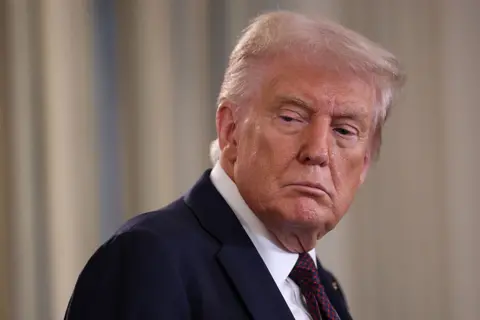
America's Supreme Court begins its current term this Monday featuring an docket presently loaded with likely significant disputes that could determine the limits of executive presidential authority – plus the prospect of additional cases approaching.
Over the eight months after Trump returned to the executive branch, he has tested the limits of executive power, unilaterally enacting new policies, reducing public funds and workforce, and trying to place formerly autonomous bodies closer under his control.
Constitutional Conflicts Over State Troops Use
A recent developing judicial dispute stems from the president's attempts to seize authority over regional defense troops and send them in urban areas where he alleges there is civil disturbance and rampant crime – despite the opposition of municipal leaders.
Across Oregon, a judicial officer has issued rulings halting the President's deployment of military personnel to Portland. An appellate court is scheduled to reconsider the action in the next few days.
"This is a country of constitutional law, not martial law," Magistrate the court official, who the administration nominated to the bench in his first term, wrote in her Saturday statement.
"Defendants have made a series of positions that, should they prevail, endanger weakening the boundary between civilian and military government authority – undermining this nation."
Emergency Review Could Shape Troop Control
Once the appellate court issues its ruling, the justices could get involved via its often termed "expedited process", delivering a ruling that might curtail the President's power to employ the troops on US soil – or give him a broad authority, for now interim.
These processes have become a increasingly common occurrence recently, as a majority of the court members, in response to emergency petitions from the Trump administration, has mostly permitted the government's policies to continue while legal challenges play out.
"A tug of war between the justices and the trial courts is poised to become a driving force in the coming term," an expert, a professor at the University of Chicago Law School, remarked at a briefing recently.
Criticism About Shadow Docket
Judicial use on this emergency process has been questioned by left-leaning academics and officials as an unacceptable exercise of the court's authority. Its orders have typically been short, giving limited justifications and leaving behind lower-level judges with scarce guidance.
"All Americans ought to be worried by the justices' increasing use on its expedited process to decide controversial and prominent cases absent any form of clarity – no comprehensive analysis, oral arguments, or justification," Democratic Senator the New Jersey senator of New Jersey stated earlier this year.
"This additionally pushes the justices' considerations and decisions beyond public oversight and protects it from responsibility."
Complete Reviews Approaching
Over the next term, nevertheless, the judiciary is scheduled to address matters of presidential power – and further prominent controversies – squarely, hearing courtroom discussions and providing comprehensive rulings on their basis.
"The court is unable to get away with short decisions that omit the justification," said a professor, a professor at the Harvard Kennedy School who studies the Supreme Court and American government. "If they're going to grant greater authority to the administration they're will need to explain the reason."
Major Matters featured in the Docket
Judicial body is already set to examine if national statutes that prohibits the president from dismissing members of bodies created by Congress to be independent from executive control infringe on executive authority.
Court members will additionally consider appeals in an accelerated proceeding of Trump's attempt to remove an economic official from her role as a governor on the influential central bank – a matter that may substantially enhance the president's authority over American economic policy.
The nation's – along with world financial landscape – is also front and centre as judicial officials will have a occasion to decide on whether a number of of Trump's unilaterally imposed tariffs on foreign imports have proper regulatory backing or ought to be overturned.
Court members might additionally consider the President's moves to unilaterally slash government expenditure and terminate lower-level federal workers, as well as his assertive migration and deportation strategies.
Even though the court has yet to consented to review the President's bid to end natural-born status for those delivered on {US soil|American territory|domestic grounds


